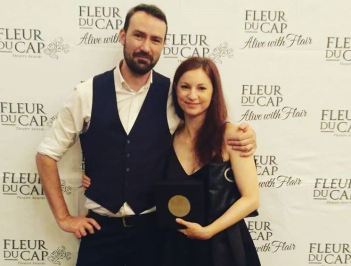
Above all to my (now) wife Suzanne, thank you.
On the evening of Sunday the 18th of March 2018 The Underground Library won Best Theatre Production for Children and Young People at the annual Fleur du Cap Theatre Awards. I was told I accepted the award and made a speech, but all I can remember is how hard my legs trembled.
From reports it seems I stuck close enough to my notes. If you had seen them, you would have read one sentence writ large across everything: There are too many people to thank them all.
Here then is my attempt to rectify that.
Tara Notcutt announced the award and that was very appropriate – she was the person I first pitched the idea to 4 years ago in Grahamstown. Tara, thank you for encouraging me from the beginning.
I wrote the first draft in early 2015 for a radio play competition (I didn’t win). Thank you to the people who read and gave me feedback: Marc Kay (who did win), Jon Minster and Melissa Loudon (who called my hacking scene ‘vaguely plausible’).
From there the script was adapted and submitted to the African Youth Theatre and Dance Festival hosted by Artscape and Assitej SA. Thando Doni directed a staged reading with a group of students. Thank you for your time and for firing me up in the talk-back. That festival was the first time I met Victoria Gruenberg, an American intern who gave me thorough, insightful and challenging notes, and my introduction to the roll-up-your-sleeves-and-work attitude of US writers.
From that festival it was selected to be a part of New Visions / New Voices in the USA – an opportunity created by Assitej SA and the Kennedy Center in Washington DC. Most costs were covered but I still had to raise money for flights.
As part of fund-raising we hosted a reading of a new draft at Alexander Bar. Jason Potgieter directing Faniswa Yisa, Mvelisi Mvandaba, Callum Tilbury, Richard September, Sive Gubangxa, Maggie Gericke, Cleo Raatus. You can listen to that early draft here: alexanderbar.co.za/undergroundlibrary
Fundraising for New Visions / New Voices (NV/NV) was an outpouring of support from family, friends and peers. Thank you all so much: Ma and Pa, Helen and Fumi, Malc and Jill, Sarah and Simon. Sanjin Muftić, Jayne Batzofin, Carla Lever, Andrew Whiting, Jennifer Downs, Karl Haupt, Aleida Heyns, Sandy Jeffery, Fred and Joy Boerlage, Ann and Jannie Wiegman, Blythe Linger, Melissa Loudon, Gaëtan Schmid, Helen Moffett, Wenda Redfern, Natasha Norman, Simon Cooper, Teri Davidoff, and Suzanne Duncan – who 2 years later is my fiance and my wonder every day.
(I may have missed donors, not every deposit had a decipherable code. Please let me know if you’ve been skipped.)
That got me to America for the first time in my life. The process was split into 2 parts, both rigorous examinations of the script. I lost track of how many drafts I was on by the end of it. I need to thank the fellow writers I went on the journey with: Vinati Makijany, Deepika Arwind, Sunil Bannur and my South African peers Tamara Guhrs, Lereko Rex Mfono, Mojalefa Samson Mlambo, and Koleka Putuma – whose talent as a poet and theatre-maker I am in awe of.
The experience was made possible Assitej SA, the Kennedy Center, The University of Maryland. Thank you people n all the organisations who made it possible: The leaders, the administrators, and the directors, dramaturgs and actors who gave notes, perspectives and their voices to bring the plays to life. Thank you Kim Peter Kovac, Patrick Crowley, Moriamo Akibu, Jeffrey Kaplan Lew Feem, Justin Weaks, Teresa Fisher, Karin Serres, Scot Reese, Meg Lowey, Faedra Carpenter, Deirdre Lavrakas and more, more, more (I want to name *all* of you individually but I didn’t keep careful enough notes.)
Returning I applied for funding supported by Maggie, my fearless assistant in all things bureaucratic and tea-fuelled.
We received funding from The Department of Arts and Culture and everything was on track to put together a full production at ASSITEJ International’s World Congress in 2017 at the Artscape.
Koleke Putuma led the creative team as director. Merryn Carver designed and made the wonderful costumes. Philip Kramer built the steel set. Dylan Owen did sounds and score. A special thanks to Shen Tian, whose otherworldly command of LEDs gave us a unique lighting feature that pushed the play into the dystopian future (10/10). Dara Beth was a excellent stagemanger to herd the talented cast: Thando Mangcu, Tankiso Mamabolo, Kathleen Stephens and Dustin Beck joining Maggie and Cleo from the first reading.
And the audiences who came to watch. Thank you, thank you, thank you.
So much of this process has been made possible by Assitej South Africa. Yvette Hardie and her team (special shout out to Yusrah Bardien and Jaqueline Dommisse) have built up theatre for young audience in this country and made a mark globally. Through their opportunities I have visited Rwanda, Sweden, Austria, India and the US. I have made new friends, found inspiring collaborators and insightful peers. I have been supported in the creation of new works – some of which continue to generate income for me.
It is in recognising how much I have gotten from Assitej SA that I pledge the prize money to them. I believe that we need organisations that grow and develop new writers, directors and performers. We need more theatre because theatre can change lives. It has mine.
Thank you for reading.
 Jon Keevy