Writer’s Block and a Writer’s Workout
Too often I can’t write. I stare at the screen. I stare at my keyboard. I stare at my sandwich. I decide I need to clip my fingernails, vacuum the carpet, and bake a complicated supper I only have one ingredient for.
 Writer’s block is the single biggest reason I don’t often think of myself as a writer. If I was really a writer, surely writing would be easier? But I’ve fought this battle before, quite a number of times. People who know me well can tell when I’m in a slump because I stare at nothing, get up and wander around and open the fridge without taking anything out. Also I look depressed. I am. But it’s the flip side of the beautiful moment when you are on a roll, when the words just flow. And not just any words – submerged themes surface and become clear, motivations and solutions to plot problems are as obvious and imminent as the end of this sentence.
But I’m not preaching that writer’s block should just be accepted, I think it’s a time for you to grow by trying different things. Writer’s block can be the hesitation when I’m about to finish a sentence with a cliché or it can be the days spent reading while a character hangs over the chasm between point A and B. The most basic thing writer’s block teaches you is humility. Writing isn’t easy. Yet of all the arts it’s the one that people take up with the least preparation. Writer’s block is the cramp you get because you didn’t stretch before you hit the mat, the canvas you wasted because you didn’t do any pre-sketches.
This is how I deal with writer’s block when it happens and before it happens. Most of these things are obvious and I probably got them from any of the hundreds of books, articles and blogs on writing I’ve read. I know they work because I’ve been doing this for a decade and I’ve spent most of that time not writing. That I can work consistently now is not a result of a change in my timetable, it’s because I prepare before I write.
1.) Keep a journal
Don’t worry about being profound; don’t even worry about being accurate. Just write every day about what has happened to you, about what you did. It gets you in the habit of writing even when you have no projects on the go, or you can’t stand the thought of being creative. I always carry around an A5 notebook; a day is usually 2 pages and takes me less than 15 minutes. I do it while I wait for food to cook. In Cape Town, if you’re punctual you’re in the minority with me – but that’s fine. In those ten or fifteen minutes spent waiting every day I have all the time I need to keep my journal up to date. Beyond its help with your writing, keeping a journal will be the best investment you ever made. Don’t lose all those memories and experiences. I only started 2 years ago and I kick myself I didn’t start sooner.
2.) Build good habits, vary them
This is just good advice for everyone who wants to be productive and creative. The key is not to start with your dream timetable. You wouldn’t make a resolution to do a hundred pushups everyday and start there, would you? No, if your goal is to be writing for 5 hours every day, or 3000 words, or ten pages, then you set your short term goal at half an hour, 500 words or half a page. Make it stick, and then build it up. So you’ve got your goals, now fit them into your timetable. So simple! It’s like… wow. The catch is to make the schedule flexible enough that you can try new things out. I like to write in different places, not just on my home PC. I often write in coffee shops, galleries, parks – places that offer a change of scenery and thus a different perspective. A favourite of mine is the Natural History Museum. Also try to figure out what time is your best time for writing, not in terms of convenience but in terms of your energy, your creativity. Now take risk and try a different time. The results can be surprising.
3.) Free write: Use the Cards
OK, here are some resources for you. You’re going to need a pack of cards to use them. This is the core of my writing work out. Deal yourself 3 cards, one for each of the tables.

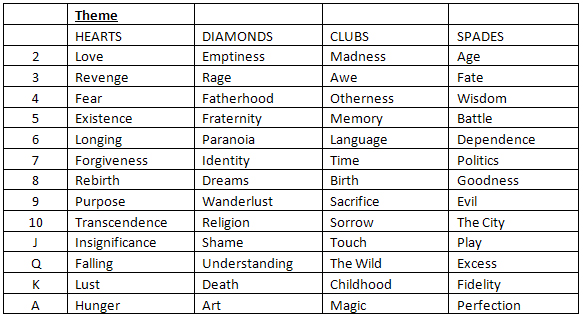
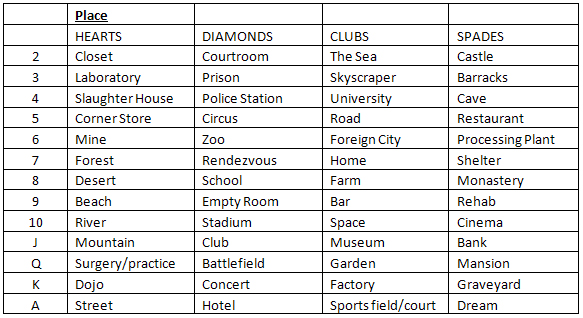
Now start writing about these. I like to remember the TheatreSports™ adage: “When you get a horror, start with two grannies knitting.” Meaning, don’t start with a character holding a shoe, standing in a cupboard, talking about loss. Actually, you can. Do it. It sounds like it could be great. I keep writing for at least an hour for this exercise. If the scene gets stale, if you start slowing down, then start over with 3 new cards (you don’t have to start the clock again). These scenes aren’t important. They don’t have to connect to anything. They don’t even have to be any good or make sense. They are lifting writing weights so your endurance and clarity get stronger.
4.) Read about Writing, Write about Reading
I assume you’re already reading prose, poetry, scripts and news reports. (If you’re not why exactly do you write?) Read books about writing too. Most of them are crap – only good enough to be short articles on a blog. But there’s always something useful, some tip, an exercise or a quote that makes it worthwhile. Frequently they have recommended reading lists at the back that point you to better, wiser gurus. I’d recommend Story by Robert McKee, 3 Uses of the Knife by David Mamet, The Hero with a Thousand Faces by Joseph Campbell and On Writing by Stephen King.
Keep track of what you read and what you learn. Like a quote? Write it down. Summarise, review and preserve what you read. Memory is fallible, that’s why writing was invented.
5.) Try different styles
With your wide reading you should be exposing yourself to different genres and eras. And not just fiction – read reports, academic treatises and biographies. Try text books and encyclopaedias. Dip into letters and poetry. Right now I’m going through H. Rider Haggard’s Allan Quartermain and the tone and sweep of the prose is fascinating. Try writing something in one of these styles.
A project I’ve been working on the background for quite a while is a science fiction novel. It requires a lot of notes to track the invented cultures, histories and geography. Instead of keeping these as bits and pieces I’ve been writing ‘academic’ articles and fragments of journals and letters. It works for me because I’m a geek and a big fan of Borges. But try it out next time you’re doing a plot summary or a character sketch. It’s all about finding a voice.
6.) Skip ahead
Sometimes I can’t get characters from point A to point B. The plot seems to make sense but there’s a gap of action that sinks my best efforts. Mostly it’s because I don’t know enough about where the story is, geographically, or I haven’t spent enough time with the characters. It can be tempting to solve every problem as it comes up while you’re writing but the most important thing is momentum. The first 30 minutes of writing are the hardest, stick to it though and you’ll see the reward when you really get in the groove. Stopping to google a map of the city or the history of the cardigan is not going solve the greatest concern, the story.
7.) Never be afraid of starting over
Last year I had a hard drive crash and my back up failed in a series of unlikely events. I lost 90% of 3 years of writing. But it might as well have not existed. Nobody is poorer for its loss. In fact, I may be better. I think that this world tells us that work that produces nothing tangible is wasted; I think that’s wrong. Whenever we have to start over we’re never really starting from scratch, even if we have no words or materials. If you continue to build something up on unsound foundations your finished product will be unsound, that is real wasted effort. Stopping half way and then starting over to create your best work takes patience and effort, but I believe it is the only worthwhile way to create art. I was forced to look at the foundations of my work, the hardcopy notes I first made of the stories. I had to ask myself in each case what was worth rebuilding, and why.
 Drive or walk around the city and you can see my work. A blazing sunset with a thorn tree silhouetted against it. Three small figures can be seen under it, while a flock of birds pass overhead. “Athol Fugard’s The Bird Watchers” the title states in letters taller even than municipal regulations would have them. It’s not the kind of poster I generally like, I’m not a fan of landscapes and the iconography is a touch too clichéd (I should probably mention that I am the designer, but I’ll leave that hanging). But it does make sense in the context of the story Fugard tells, if not with the scenography of Saul Radomsky. Fugard is a writer driven by the wisdom: “write what you know” and in the Birdwatchers he draws on the setting and memories of his conversations with Barney Simon and Yvonne Bryceland. The Central character is Garth, a writer revisiting a time with Lenny, a director, and Rosalyn, an actress. But these roles don’t sum up the relationship between the 3 of them. The play comes in two acts split by an interval and an understaffed scene change. The first half is set in the real world, under the unGwenya tree of Garth’s home and the second is a return to that place and time by an aged Garth in his imagination. The stark simplicity of the stump of the tree and the sear decay of his re-imagined home was biting. The story is a self-flagellation as Garth regrets words, attitudes, selfishness and wasted potential. What I found to be greatest flaw and also the most thought-provoking aspect of the production was this self-absorption, a feedback loop of pain. At one pointed I wanted to give Uncle Athol a hug, in part because a lot of his cutting words I’ve used on myself many times.





 Jon Keevy