Inspiring a Generation, No Really.

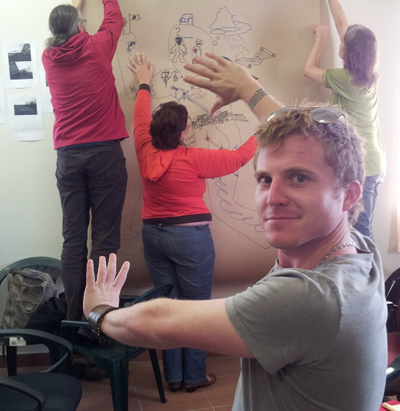
Beren directs some Inspiring action

At the beginning of the year I was chosen along with Lindelwa Kisana, Beren Belknap and Frankie Nassimbeni to take part in ASSITEJ SA’s Inspiring a Generation programme. It’s a collaboration with ASSITEJ’s Swedish chapter whose goal is to encourage more quality plays to be written for the youth. At the beginning of the month our counterparts arrived and we spent a week doing workshops lead by Karen Jeynes and Lucia Cajchanova. In three weeks we’ll be going to the Bibu.se Festival in Lund and will be presenting scenes and the first draft of our plays.

Whenever I need inspiration, or my process stalls, I turn to Robert McKee’s Story. I randomly opened it and got this:

“At last he [the writer] has a story. Now he goes to friends, but not asking for a day out of their lives – which is what we ask when we want a conscientious person to read a screenplay. Instead he pours a cup of coffee and asks for ten minutes. Then he pitches his story.”

The exercise of writing out the story inevitably leads us to write out what happens. But this is not story. The story is the distillation of what happens, the spine under the actions and events that gives them meaning. Telling a story is to select moments out of the infinite scope of ‘what happened’ (for in fiction anything is possible) into an emotionally moving sequence. When you tell someone your story out loud you’ll see if it works in their face and their body language. Then you’ll know if you have story that’ll hook your audience or just a list of things happening.
Owl at the Kalk Bay Theatre

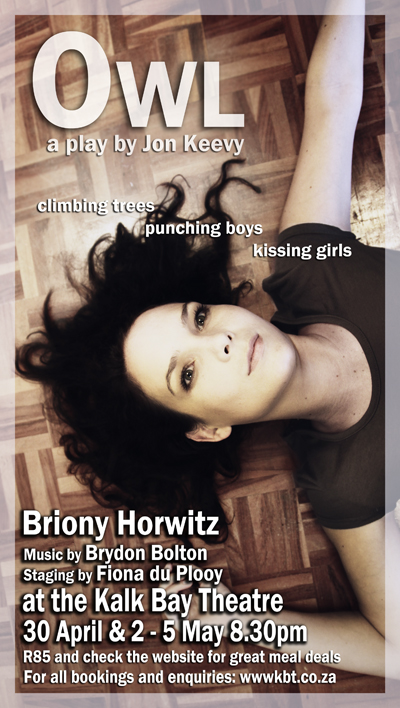
Briony and I have been spending most of the last week by sea. As you can guess by the overcast skies and glowering downpours, we weren’t lying on a beach. We were holed up at the Kalk Bay Theatre, getting rehearsing for Owl. We’ll be running there for a week; we were invited when 2 weeks ago when a gap came opened up in their schedule. So we’ll be opening on Monday the 30th April and then running from Wednesday til Saturday 5th May. The show is at 8.30pm. All the booking is through the Kalk Bay Theatre – www.kbt.co.za – and they have some great meal offers for their restaurant right above the stage.

This time around Christine Skinner is handling the publicity and we’ve had a photo in the Argus and a give-away in the Cape Times. Here’s a link to an interview I did with Daniel Derckson for his newsletter, The Notepad. And on Sunday Briony and I’ll be interviewed by Jonathan Duguid on UCT radio at 1.30pm.

We’re very excited to be doing the play again and this run gives us a chance to try out some changes before we head up to Grahamstown.

The Kalk Bay space is very different, a wide stage with audience nearly 180° around it. This makes the blocking a challenge and we decided to have a bit of fun with it while opening up and simplifying the lights. But the biggest changes are to the text. Nothing fundamental – I rewrote one scene completely and added bits and cut others to try and drive the characters’ along more. Then I also put back a scene that sort of slows and shifts the mood, the exact reasons we cut it in the first place.

If you do see Owl for a second time, I’d be really interested in hearing your thoughts on the changes – you can email me or post on the blog.

Direct it Yourself

Warning: This Post May Contain Traces of Nuts

Heeeey… so you’re a writer? You’ve been sitting in front of a computer screen, hunched over and away from natural light or maybe you’ve been sterilizing your baby-maker by perching a humming laptop on, obviously, your lap. I can tell these things. You’ve probably spent a couple of weeks or years working on your script. You’ve revised it, rewritten it, thrown it away and started over a couple of times. But now it’s ready. What do you do now?

Direct it yourself.

No, no, no! That’s what everyone tells writers not to do! You need another mind on it, you need a trained director to shape and mould it – someone who has experience, or a degree, or something.

And they’re right. A good script does need all of that to reach its potential.

But …

Have you ever heard a director say he has an idea for a production and get this advice: “Great idea, go find someone to write it for you. You need another mind on it, you need a trained writer to shape and mould it – someone who has experience, or a degree, or something.” I haven’t.

Writing is regarded as an innate skill in the Cape Town theatre industry. Everyone has it. While overseas the writer/director is a rarity, here it is almost impossible not find a director who is also a writer. And it requires very little to bring out this wonderful storytelling ability that lurks in the heart of talented people. You don’t need to study a degree or even read a book on it; after all you’ve read/watched /listened to stories your whole life. What if I was to say the same about directing or acting? UCT has 4 year long programmes for each of these. But not for playwriting, that’s something you’re meant to have picked up along the way.

When a person is a writer first they create opportunities for actors and directors. They often take on the role of producer too. Look around: Nicholas Spagnoletti and his play London Road; Duncan Bulwalda and Dream, Brother; Louis Viljoen just finished a run of his new script The Verbalists at the Arena; Amy Jeptha who is too prolific to cite only one example;  and, yes, me.

Directors generate jobs often – for actors, designers, techies and musos. Actors generate jobs too. But in all my wracking of my brain the only independent production I could think of where a writer was approached to write something is Damage Control. Well played Lauren Steyn.

Independent theatre doesn’t generate jobs for writers but writers generate jobs for independent theatre all the time.

This is an absurd situation.

The One Hour Rule

Since Owl finished I’ve been pretty overwhelmed. I’ve let things slide and even the work I have completed well was done in a state of anxiety. I’ve been staring at the pages and pages of To Do lists and feeling my guts knot. I don’t think it’s unique to theatre people – this problem of too many pots too watch – because really it’s a problem of managing time. I wanted to balance the administration projects (Cape Town Edge, 2 Godfrey shows for the NAF, Owl, Inspiring a Generation, and self promotion) with my creative projects and ‘workouts’ – time spent sketching, free writing, etc. So I took inspiration from a Lifehacker article on Jerry Seinfeld. No really. Basically you work by breaking the problem into units, generally of time but they could be discrete tasks that are roughly equivalent. So instead of Spring Cleaning and spending an entire day putting your home in order, everyday you’d do 3 chores like tidy 1 room, sweep another and scrub the bath. Instead of solving the problem you’re managing it.

I’ve been trying it this week and it is gold. There is a satisfaction in working toward the final goal where before there was only satisfaction in completing a task.