Awards Shmwards

Awards are great – recognition descending from on high to give you a firm slap on the back. An award tells people that you’re one of those rare artists doing good, making work and being successful. If it comes with cash you can even pay rent this month. The glamour of the ceremony, the snacks, the champagne… rubbing body parts with the movers and shakers of the industry.

I got my first award in 2013… what a day. I was elated. I was free with my high-fives. It felt good. I’ve gotten a couple more since then and it’s a thrill every time. Getting an award is almost enough to quiet that niggling voice in the back of my head… that maybe… possibly… awards aren’t great. That awards may actually be the opposite of great. That awards maybe actually be terrible.
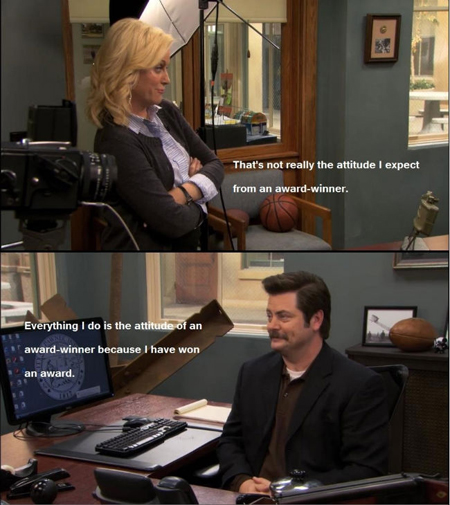
everything-i-do-is-the-attitude-of-an-award-winner

Awards are inarguably good for two entities: The organisation giving the award, and the individual receiving it.

We’re in an incredibly unequal society. Awards can function to pick out talent and push it forward, forming part of a virtuous circle (the opposite of the more famous vicious circle – a virtuous circle is where good things lead to more good things, a positive positive feedback loop). This can be a force for social change, combatting the inequalities of the system, but only if that is a conscious goal of the award. We see this in targeted awards for basically everyone who isn’t a white heterosexual male, they are addressing persisting historical equality.

In these virtuous circles sit not just awards but many opportunities that we want to believe are based solely on merit. But the rewards are disproportionate, the person who came second rarely gets any prizes and certainly not the publicity that leads to more offers of work. One instance of this is fine, it’s the circle we should worry about. Let’s take a look at a kid who went to a school with good drama program, they audition against others who have passion but no training. They get into a top tier university with opportunities for bursaries and residences. Their peers are mostly like them, passionate with a talent that has already been nurtured. Competition and collaboration drives them further. By the end of their university career they take a production to the Student Festival at the National Arts Festival. They win some categories like best production, best writer, best director. Part of their prize is to present a new show at the next NAF. Focus is on them and they get an Ovation award. The next year it’s the Arena program. A virtuous circle.

How far back do you trace a person’s success? Is my career dependent on growing up in a house filled with books? Or unconsciously absorbing the cues all around me that told me I could do whatever I wanted? Is it being brought up in the language of the global hegemony?

There are advantages being handed out all around us all the time. I believe that talent, intelligence, and passion are distributed equally across race and class. But that is not the story that the advantages handed out tell. That story is that advantage leads to advantage.

Awards and opportunities need to be open to questioning. In 2014 we saw outcry on social media about the all-male Standard Bank Young Artists for 2015 and we saw people questioning the selection process of the Cape Town Fringe. People were questioning the gatekeepers about their decisions from Maynardville to the NAF. And that’s important. Awards and opportunities innately stratify industries so we need to be aware of their effects and cautious about how they’re handled. Above all else awards need to be proportional to the achievements (and opportunities to the potential) not only of the recipient, but of their peers. Setting one person above another is a great responsibility and who ever does so must be able to answer for it.

Perhaps the best way awards contribute to change is in their fallibility – the value of high profile awards like the Grammies, the Oscars, or the Standard Bank Young Artists is that we see how untransformed we are clearly. It is an opportunity for us all to address it.

11 x 11

There’s a pleasure in symmetry, a pleasure in pattern. Rituals and habits are reassuring. Looking at 11 x 11 with its palindrome promise, makes me think it doesn’t stand for anything out of the ordinary. It can’t represent anything challenging or impossible. Can it?

As a matter of fact it can. 11 x 11 is a project I’m embarking on, a gauntlet I’m throwing down against my common sense. It stands for something a bit ridiculous in its audacity: a promise to write eleven plays in eleven months. One play every month from January to November.

This year I’m not producing any shows. I’ve produced eight shows in the last five years (four of which I wrote) and it is time for a break – time to rethink my strategy. What better way to do that than to rewire how I think about writing? If you’re like me you’ve got a folder of ideas and bits of scenes lying around, maybe a couple of promises to write the script of an idea that your table of drunk friends came up with. If you’re like me you’ve got the material, you just sat on it.

11 x 11 is about quantity, not quality. None of these plays needs to ever be produced. The goal is not the stack of pages but the experience and the practice. What does it take to be prolific? How will my process change? What will I learn from this?

The rules are simple. I have to finish a play by the end of every month. It should be about an hour (or more) so if it’s a one hander then over 20 pages, and if it’s dialogue over 30 pages. So I’ll be writing between 220 and 350 pages.

Best of all? I’ve already started and have 8 pages to go to meet my target by the 31st. This is possible and I am going to do it.

Audition Notice

Hello Cape Town,

In the wake of the vicious racially motivated attacks that have shaken and shamed Cape Town my mind has been in turmoil. How do I respond to this, as a white South African male, as a writer, as a Capetonian? How can I re-examine the city? I wrote, returning to reflections and a short story I wrote in 2007 as a springboard to articulate the inchoate feelings in me. The result is the seed for a new production and a collaboration with the brilliant Jason Potgieter.

We’re looking for two male performers between 20 and 40 years for And Other Events (working title). Written by Jon Keevy and adapted and directed for the stage by Jason Potgieter. This is a play about race and rage and the city, performed mainly though voice work so we are looking for strong vocal performers interested in tackling a tough subject.

Details:

  • Email your CV & headshot to productions@jonkeevy.com to schedule an audition. Only by confirmed appointment please. Regretfully we may not be able to see everyone because of time constraints. We also can not do skype or taped auditions.
  • Candidates must prepare a poem of their choice for presentation. Limericks and Haiku excluded. Unless you can make it work.
  • Audition duration is 15 – 20 minutes.
  • This session will be split into solo presentation and working in a pair with another auditioning performer.
  • We are looking for: Strong vocal quality (clarity, projection, energy), varied local accents; ability to evoke and sustain audio-imagery through voice; playfulness and willingness to devise vocal mis-en-scene collaboratively; realistic, goofy, OTT and irreverent sound effects / vocal graphics.
  • Being able to sing in varying styles is a plus.
  • Candidates must be vocally warmed up for the start of the audition. So do your tongue twisters in the car, on the bus or on the train, or on foot – the looks you’ll get are great research.
  • Candidates should bring a hard copy of their CV & headshot.
  • Auditions to be held at the Alexander Bar Upstairs Theatre 76 Strand street CBD
  • Saturday 13th December between 10am – 2pm
  • Successful candidates will be notified by Monday 15th December
  • Performance dates: 10 – 21 February (10 performances, may be extended)
  • Rehearsal period: 17 December – 12 February
  • Remuneration: Rehearsals will be R40per hour. Performance will be 25% of the gross (judging by other Alexander bar shows should be R3000 – R5000)
  • Possible further runs.

Thank you for taking the time to read this, please share with anyone you feel would be interested.

Journeys and tests

I had a test on Tuesday. First one in a long time. I had been to classes, taken notes, thought about how these applied to practical situations and in different contexts, and on Tuesday I sat down to see if any of it stuck.

I’m not retaking high school nor have I enrolled in a post-graduate degree. My test was sitting down with Nick and Ed and hashing out a strategy for improving our marketing; the classes I’d attended were part of a new project by British Council Connect ZA with Business Arts South Africa (BASA – yes, the same folks who gave us a Small Business award in 2013) and the Arts Marketing Association (the AMA – a UK based network of marketers figuring out how to get artists and audiences together).

The plan (which is already well underway) is for the AMA to train up four South African arts marketers, expose them to some UK practice and thinking and then use them to spread that knowledge throughout the SA arts scene by placing them with different organisations and having them help run courses on marketing. The focus being on growing audiences for art, which leads to the program’s title: Connecting Creative Markets.

As I said, the plan is already underway. Four South Africans were selected: Ukhona Mlandu, Kim Sanssoucie and the ubiquitous Yusrah Bardien (who pops up on this blog a number of times). We arrived in London to catch an early morning train through the pastoral greenery of England to get to Cambridge, home of the AMA. Already the discussions about art, politics and audiences were flowing (Ukhona has a great gift for being intense without being tense) so by the time we sat down with Cath and Laraine we were pretty certain we knew everything. Predictably, we were wrong.

Over two days we looked at systematic approaches to marketing that were at once a revelation and yet also perfectly logical. It made me realise something about myself which I think also applies to many people working in the arts: if you know how to you can achieve your goals, but knowledge is easy to come by when Google puts everything a click away… so why don’t we use it? Why didn’t I use it to market better, connect better, etc.? Because systematic thinking isn’t just knowledge, it’s a habit, one that creates time and space to work and meet your goals. Am I actually busy working toward something, or am I busy being busy?

So sitting down with Nick and Ed was not a test of knowledge gained, it was a test of will. What’s going to take our theatre to the next level is application of the strategies and techniques that the AMA has shared, and that test of will is ongoing.

Better get back to it then.


Press release stuff:

British Council Connect ZA. This project is part of SA-UK Seasons 2014 & 2015 which is a partnership between the Department of Arts and Culture, South Africa and the British Council.

Founded in 1993, the AMA is a not-for-profit organisation with over1,800 members, providing a community of knowledge for arts professionals passionate about bringing arts and audiences together.

We support the professional development of AMA members through events, courses, training and resources. We run a range of practical, strategic and conceptual level events and courses each year, in locations across the UK and online. The AMA also manages www.CultureHive.co.uk, which holds over 1,000 resources on arts marketing. These resources are easily searchable and free to download. CultureHive is part of a project managed by the AMA and supported by Arts Council England. Further information on the AMA can be found at www.a-m-a.co.uk

The AMA has invited Northern Ballet to help deliver the audience development training. Northern Ballet is one of the UK’s five large ballet companies. It performs a mix of full-evening narrative ballets, shorter more contemporary ballets and ballets created especially for children. Based in Leeds in the North of England it tours extensively to theatres throughout the UK and overseas reaching audiences of in excess of 150,000 people annually and selling £2.5 million of tickets. It was three-times winner of the Audience Award at the UK National Dance Awards, voted for by the public, and has been recognised for its work in raising the profile of dance in the UK. Its communications team received the 2013 UK Theatre Award for Achievement in Marketing and this year the Company was voted Europe’s Best Company at the Taglioni Ballet Awards. www.northernballet.com